
AI IN TELEHEALTH TRIAGE: A Primer for Triage Nurses
You have probably heard a lot about AI (artificial intelligence) lately. It is showing up everywhere: in the news, in your personal life, and now in health care. It can feel like a lot to take in.
This newsletter is a basic introduction to AI. No technical background is needed to become familiar with AI. By the end, you will have a better picture of what AI is, how generative AI differs from older tools, and why it matters for your work as a triage nurse.
Healthcare teams are exploring how to use AI safely and effectively. Please join us in learning about AI so we can ask informed questions, be curious, and contribute a nursing perspective.
What is Artificial Intelligence?
Artificial intelligence (AI) is software that can perform tasks that normally require human thinking. These include things like recognizing patterns, answering questions, making recommendations, and sorting information.
AI does not think the way people do. It has no feelings, opinions, or judgment. What it does well is find patterns within large amounts of data and apply those patterns quickly and consistently.
Think of AI as a detail-oriented analyst who is very good at spotting patterns and following rules. AI can process large amounts of information and learn to recognize what goes together. This is not because it understands, but because it has seen many similar examples before.
You Have Already Worked Alongside AI
You may not realize it, but AI tools have been part of health care for years. You have probably already used them.
Automated call routing that directs patients to the right department
Fraud detection alerts on your credit card
Sepsis screening alerts in the EHR (electronic health record)
Spam filters in your email inbox
Symptom checkers on patient-facing websites
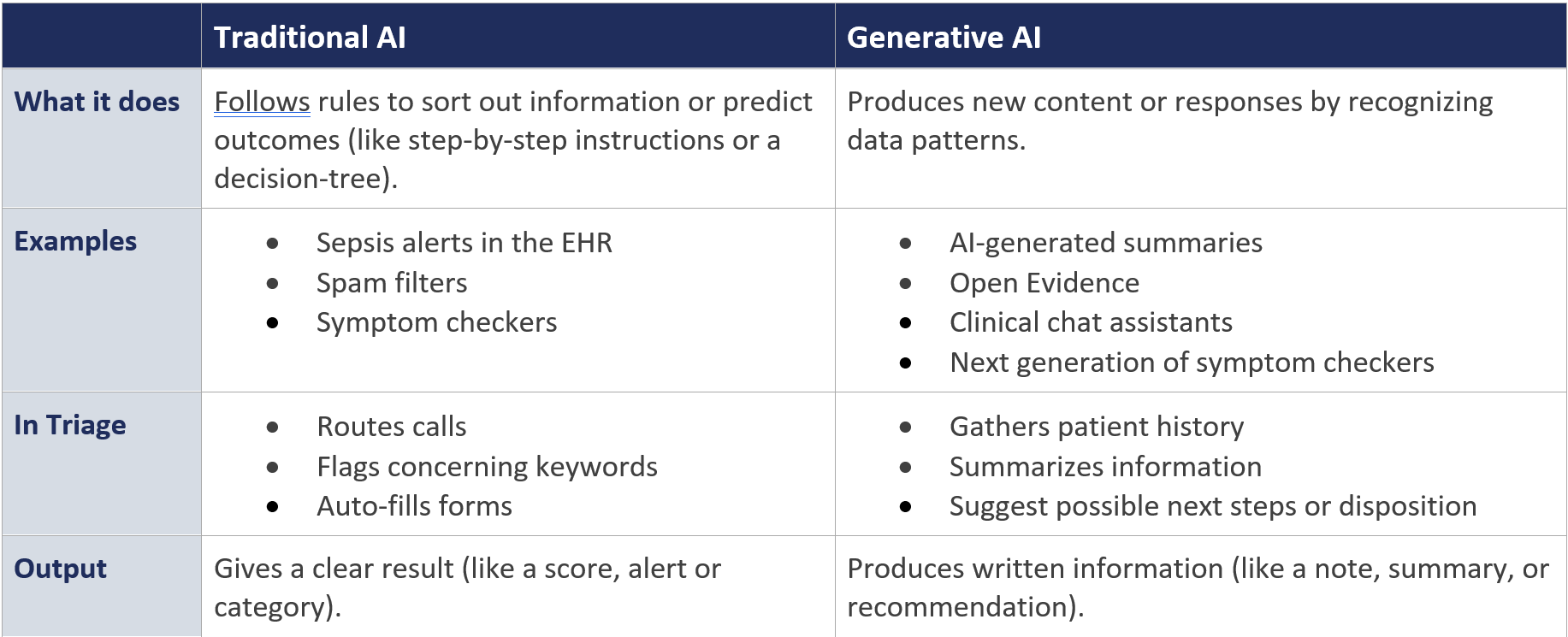
These are examples of traditional AI. They follow rules that were programmed in advance. They are designed to sort, flag, or route. They do not have a conversation with you.
So, What is Generative AI?
Generative AI (GenAI) is a newer type of AI that can produce original content: written text, summaries, or responses. It builds these from patterns that it learned from large amounts of data.
The most well-known example is ChatGPT. You type in a question or prompt, and the system writes back a response that sounds like something a person might write. GenAI does not copy and paste from a database. It generates something new each time by recognizing patterns in language. This is what makes it feel more like a conversation than a simple search.
Where GenAI Fits Into Triage
GenAI is beginning to appear in telehealth triage workflows. One growing use case is an AI-assisted chatbot that gathers patient information before a nurse takes the call. The chatbot may:
Ask the patient about their chief complaint
Screen for red flags such as sudden onset or severe symptoms
Pull in relevant history from the patient’s record
Suggest a preliminary disposition based on clinical guidelines
Hand off a structured summary to the nurse for review
Your Role Does Not Shrink. It Becomes More Important.
Understanding how generative AI works, and what its limits are, empowers nurses to use it safely and catch its errors.
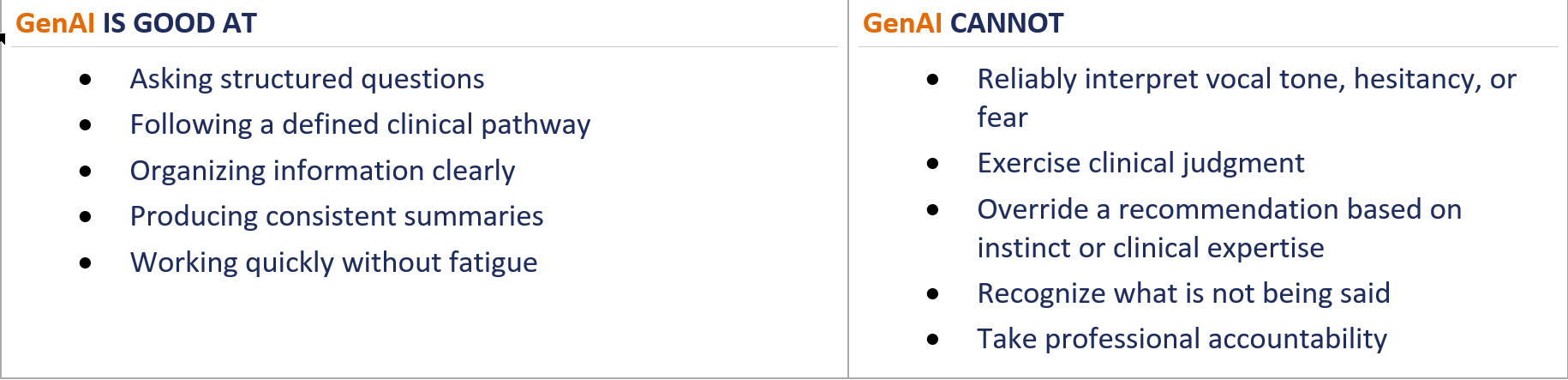
The AI does the structured intake work. The triage nurse provides clinical oversight and professional accountability.
When generative AI recommends a disposition, your clinical judgment remains essential. You review, validate, and when needed, override. The final decision is always yours and must reflect the full clinical picture.
Generative AI can also make mistakes. It can generate output that sounds confident but is incorrect (hallucinations). Nursing oversight is the critical safety layer.
Where to Start
Nurses who understand this technology will be best positioned to use it safely, catch its errors, and advocate for patients when needed. Generative AI is simply a new tool. When grounded in trusted guidelines and guided by nurse judgment, it can help sustain high-quality care while improving efficiency.
A good question to ask your manager: “Are we starting to explore GenAI in our triage workflow? How can I learn more?”
Authors
Laurie O’Bryan, RN, STCC Adult Guideline Nurse Editor
Cheryl Patterson, BSN, RNC-TNP STCC Adult Guideline Nurse Editor
Further Reading
IBM. What is generative AI? Available at https://www.ibm.com/topics/generative-ai. Last accessed August 1, 2026.
Mollick E. Co-Intelligence: Living and Working with AI. New York, NY: Portfolio/Penguin; 2024.
Laymouna M, Ma Y, Lessard D, Schuster T, Engler K, Lebouché B. Roles, Users, Benefits, and Limitations of Chatbots in Health Care: Rapid Review. J Med Internet Res. 2024 Jul 23;26:e56930.