
Nurse Telehealth Triage Contact Center Benchmarking Survey Report 2026
(With 2017, 2020 and 2023 comparisons)
Executive summary
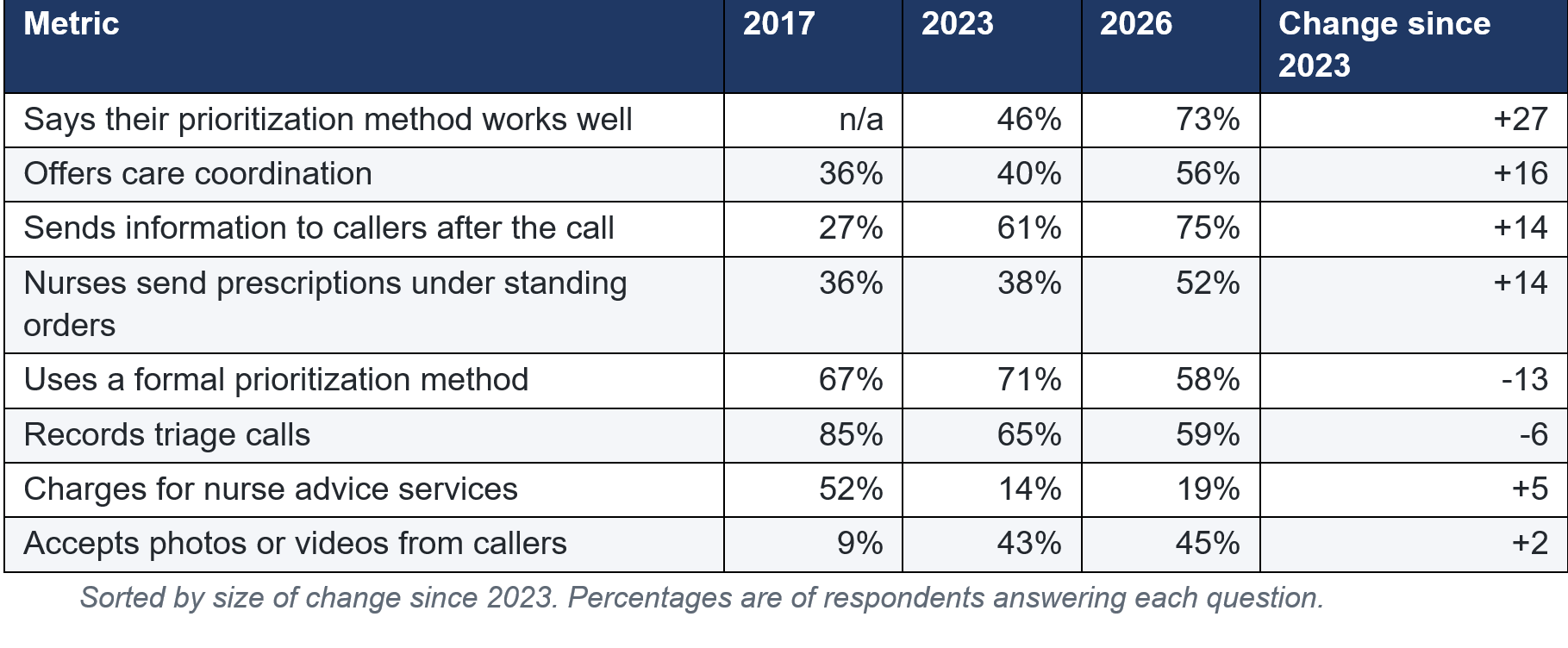
Most operational measures held steady this cycle. Call length, calls per hour, and staffing models are close to where they were in 2023. Four measures moved more than 13 points: how centers follow up after a call, whether they use a formal prioritization method, whether nurses can send prescriptions, and what other services the center carries.
Where the field moved most
Five findings
1. Fewer centers use a formal prioritization method, and more say prioritization works.
Formal method use fell from 71% to 58%. Over the same period, the share reporting that their method works well rose from 46% to 73%. Among centers that prioritize, 78% use a red flag list and 22% use an online screening tool. The written responses suggest centers dropped longer screening instruments in favor of a short list non-clinical staff can apply under pressure.
2. Call review declined while call complexity rose.
Recording fell from 85% in 2017 to 59%. Among centers that record, 4% review 10 or more calls per nurse per month and 23% review fewer than two. Meanwhile 53% attribute longer calls to higher patient acuity, and 51% of calls now involve secondary triage by a provider. More of the field is handling harder calls with less ability to review them.
3. More of the encounter happens after the call ends.
Written follow-up rose from 27% in 2017 to 75%. Photo intake rose from 9% to 45%. Ninety-four percent of nurses have the medical record open during the call and 98% of calls include documentation. Nearly all follow-up runs through the patient portal, which respondents attribute to privacy concerns about email and text.
4. Call content grew while call length fell.
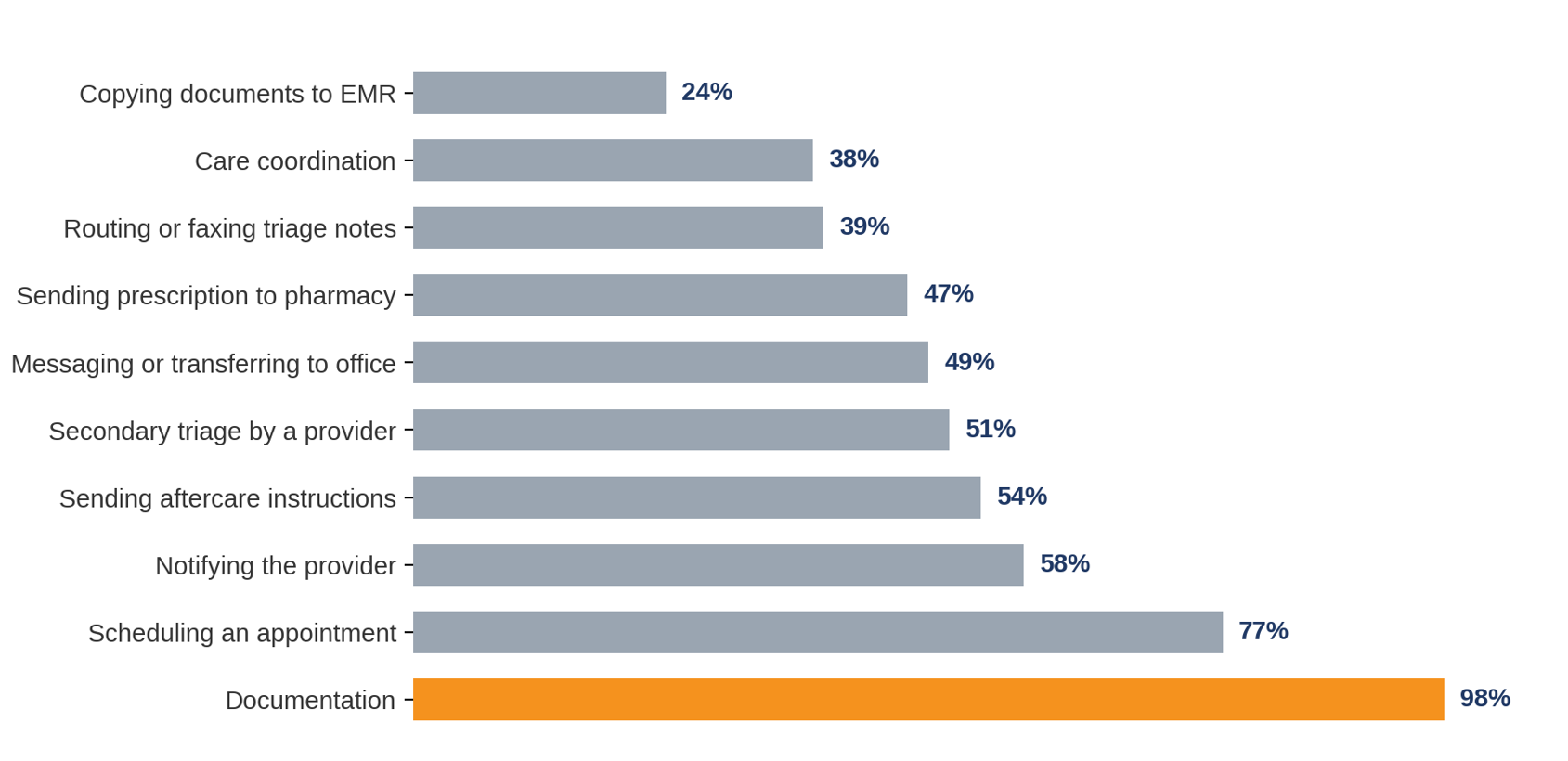
Documentation now applies to 98% of calls, scheduling to 77%, provider notification to 58%, and secondary triage to 51%. The 5 to 7 minute band still grew from 13% to 21%, and calls over 20 minutes fell from 15% to 7%. Several respondents describe moving refills and prior authorizations to medical assistant and pharmacy technician teams, which may account for part of the difference.
5. AI use is limited to administrative tasks.
Ten percent of centers use AI and 25% report working toward it. The functions named are transcription, summarization, sentiment analysis, pre-call information gathering, and quality scoring. No respondent reported AI participating in a triage decision, and several stated that boundary directly.
At a glance
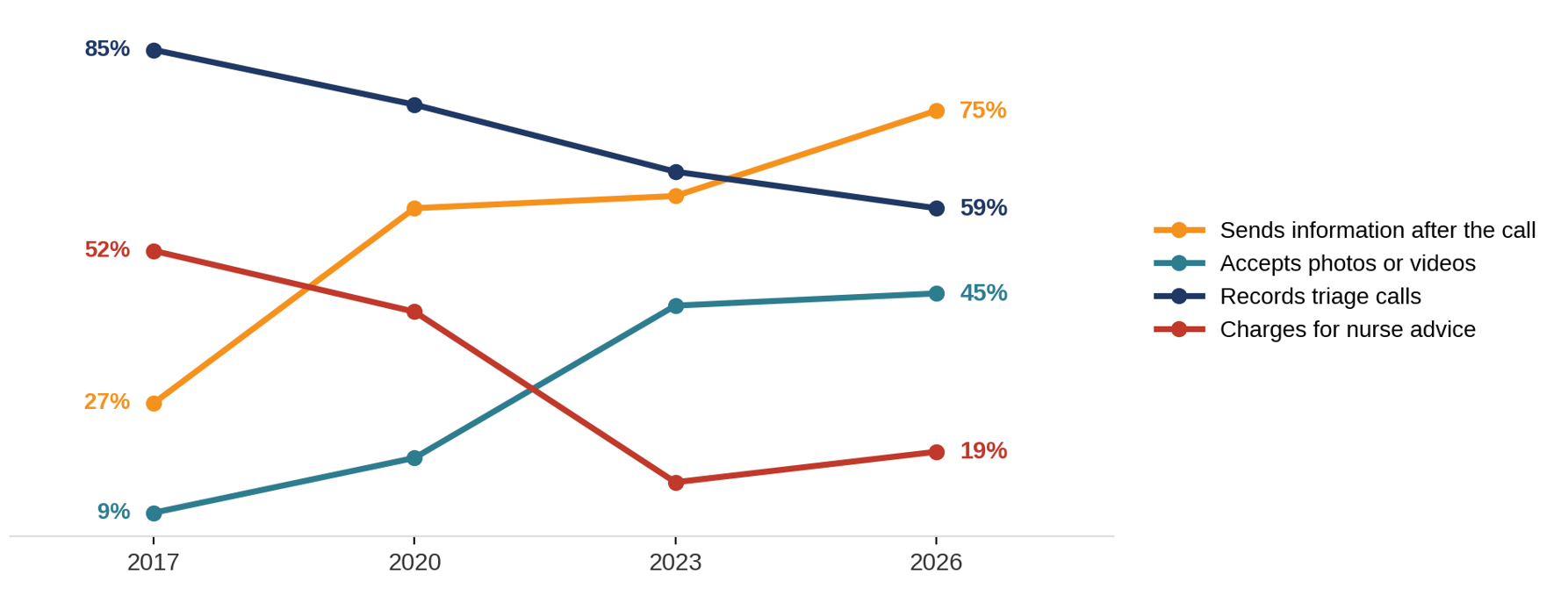
Four measures over nine years
Each of these moved more than 25 points since 2017.
Most calls include work beyond the conversation
Documentation applies to nearly every call. Half involve a second clinician.
1. Inside the call
Call time, workload, and what nurses do while the caller is on the line.
The call length distribution shifted shorter
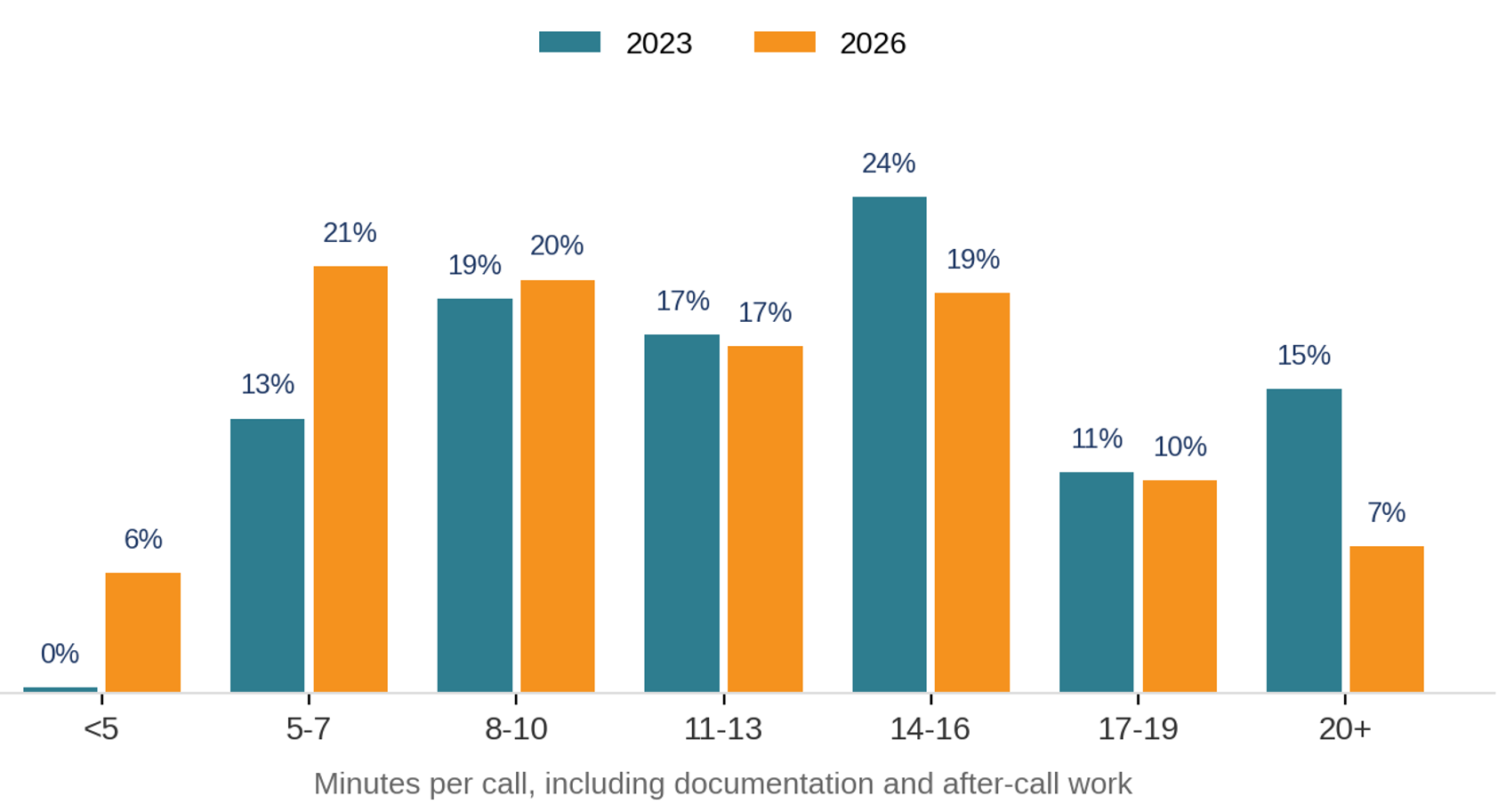
Short calls grew and long calls shrank. The 5 to 7 minute band rose from 13% to 21%. Calls lasting more than 20 minutes fell from 15% to 7%. The middle of the distribution barely moved.
Comments on call time variation
Actual triage assessment and documentation time is 8 to 10 minutes, but coordinating efforts and consultation can add 10 or more minutes depending on how quickly clinicians respond.
Behavioral health calls can last over 30 minutes. Calls needing an interpreter run longer because of the three-way connection.
Reported direction of change differs from the distribution
Thirty-two percent say calls have gotten longer over three years; 19% say shorter. That runs against the distribution above. One explanation is that the calls nurses recall are the difficult ones, and those did get harder.
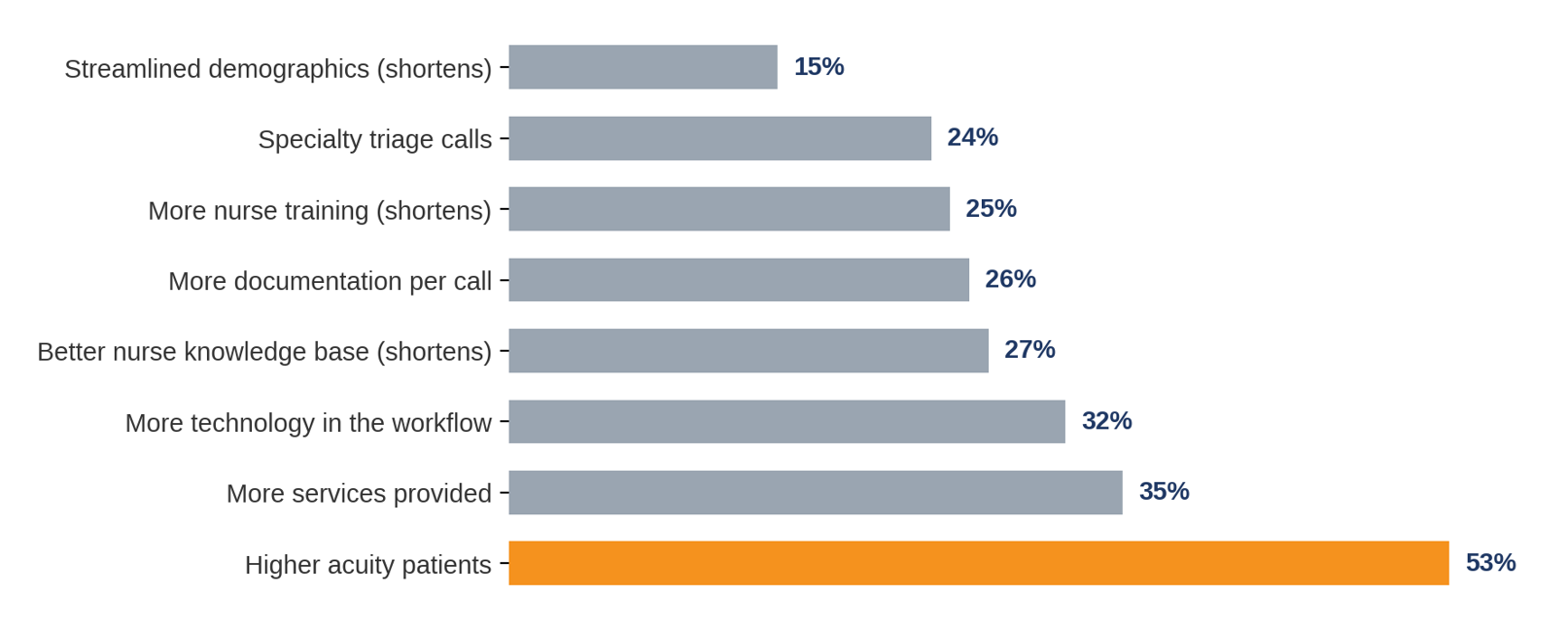
Higher patient acuity leads at 53%, ahead of added services at 35% and new technology at 32%.
Three to four calls an hour remains typical
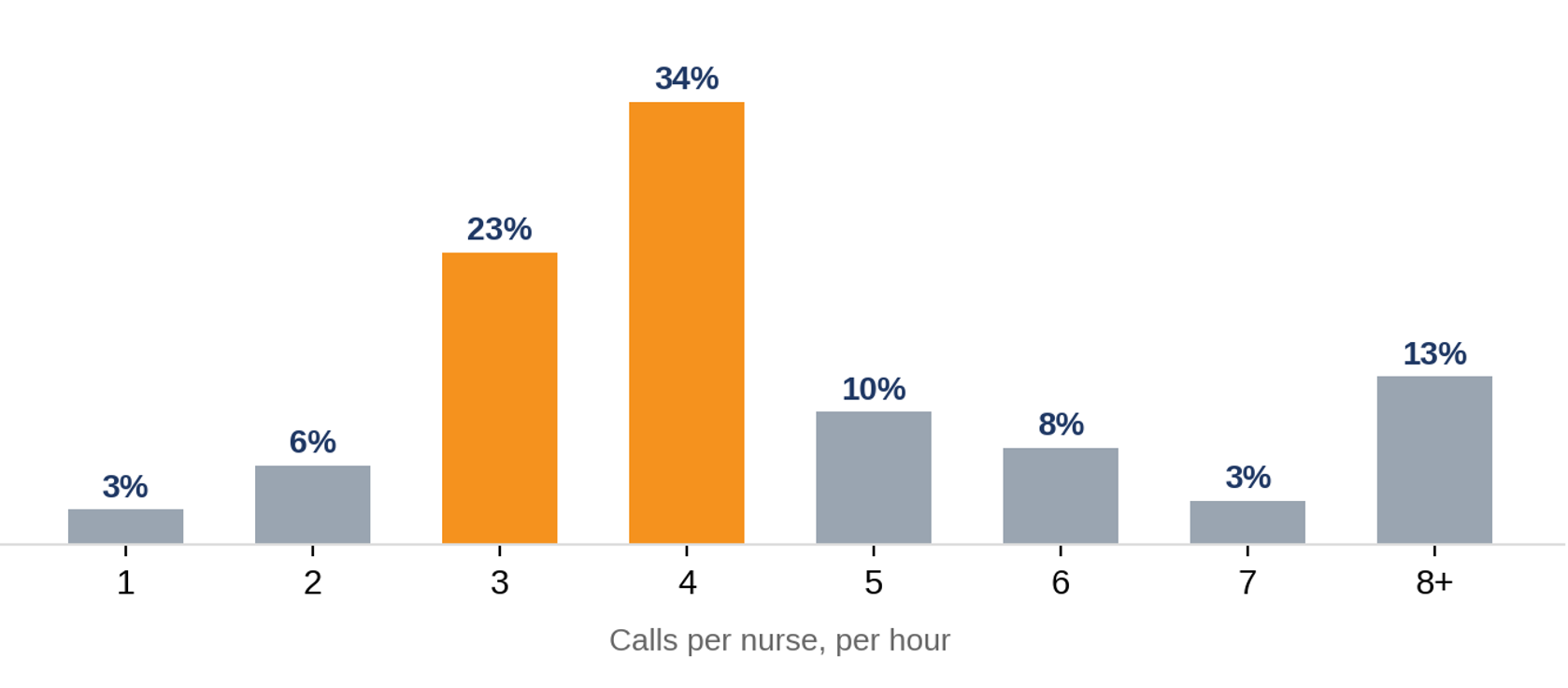
Fifty-seven percent of centers report 3 to 4 calls per nurse per hour. About a quarter report 6 or more. This has held across all four survey years.
Ramp time
One center describes the progression: nurses hired from acute care settings run about 4 calls per hour for roughly six months after orientation. Experienced, highly productive nurses reach 6 to 7.
Nurses consult the provider rather than transfer the caller
Consulting and calling the patient back rose from 43% to 57%. Holding the caller while consulting rose from 24% to 42%. Direct transfer to the provider stayed near 16%.
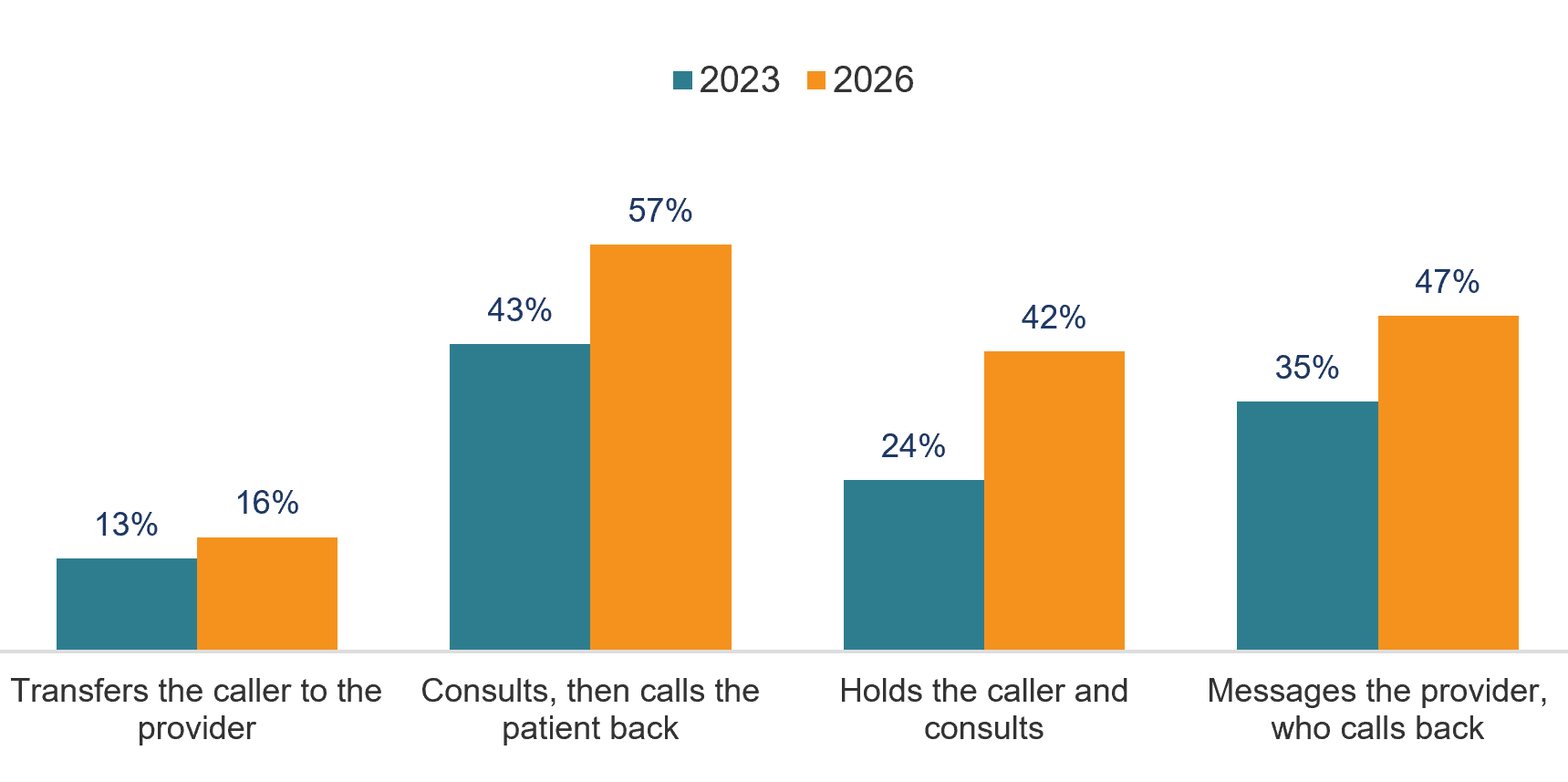
Second level triage also became less formal. In 2026, 54% of centers use it sometimes or on occasion, 34% always, and 16% never. Combining the first two gives 88%, against 49% who answered a flat yes in 2023.
2. Getting to the right nurse
Direct nurse answering returned to its 2020 level
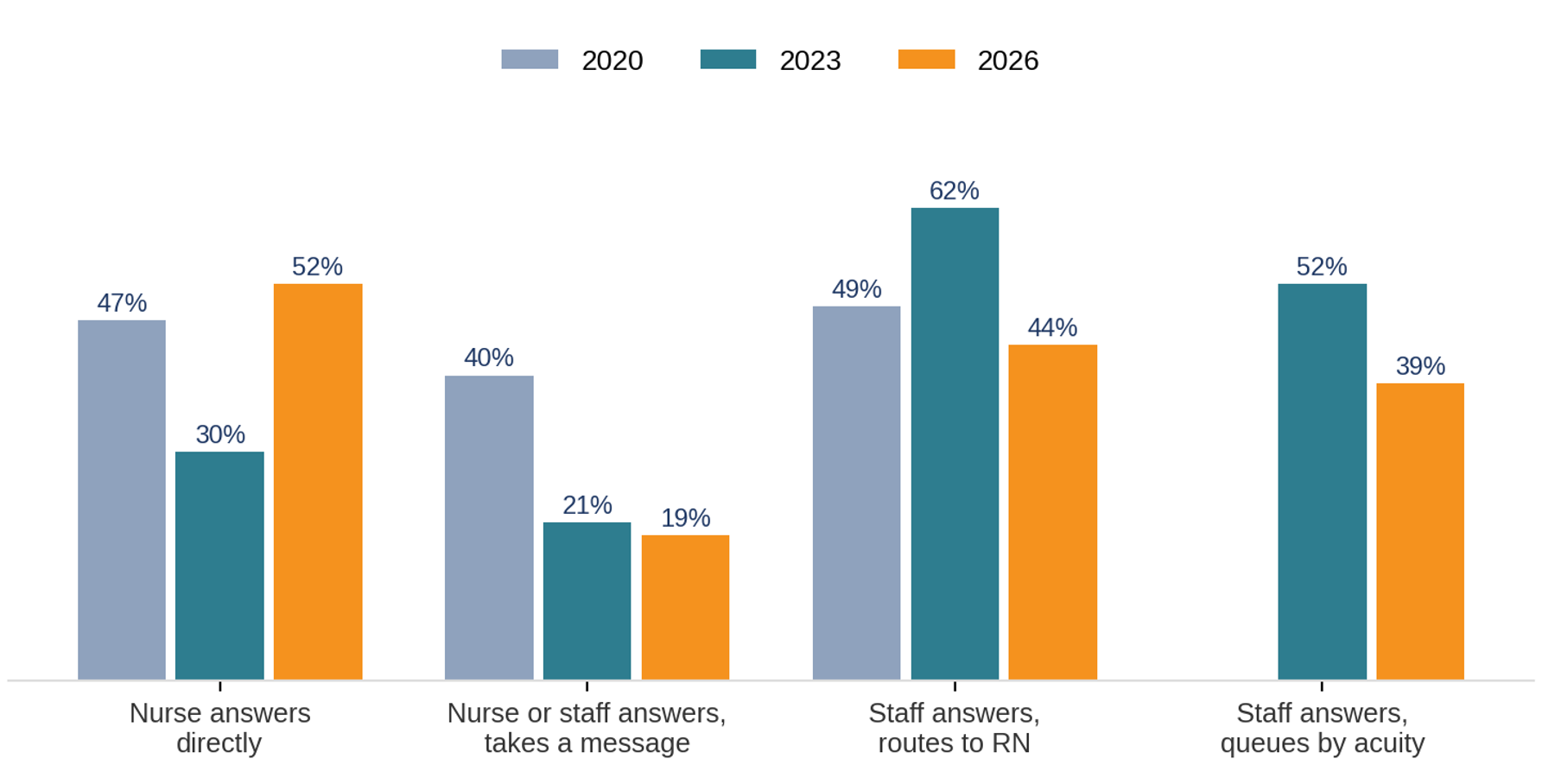
Nurses answering calls directly rose from 30% in 2023 to 52%. Twice as many 2026 respondents manage pediatric patients only, which may account for part of the change.
Two prioritization measures moved in opposite directions
Formal method use fell from 71% to 58%. Satisfaction with the method rose from 46% to 73%.
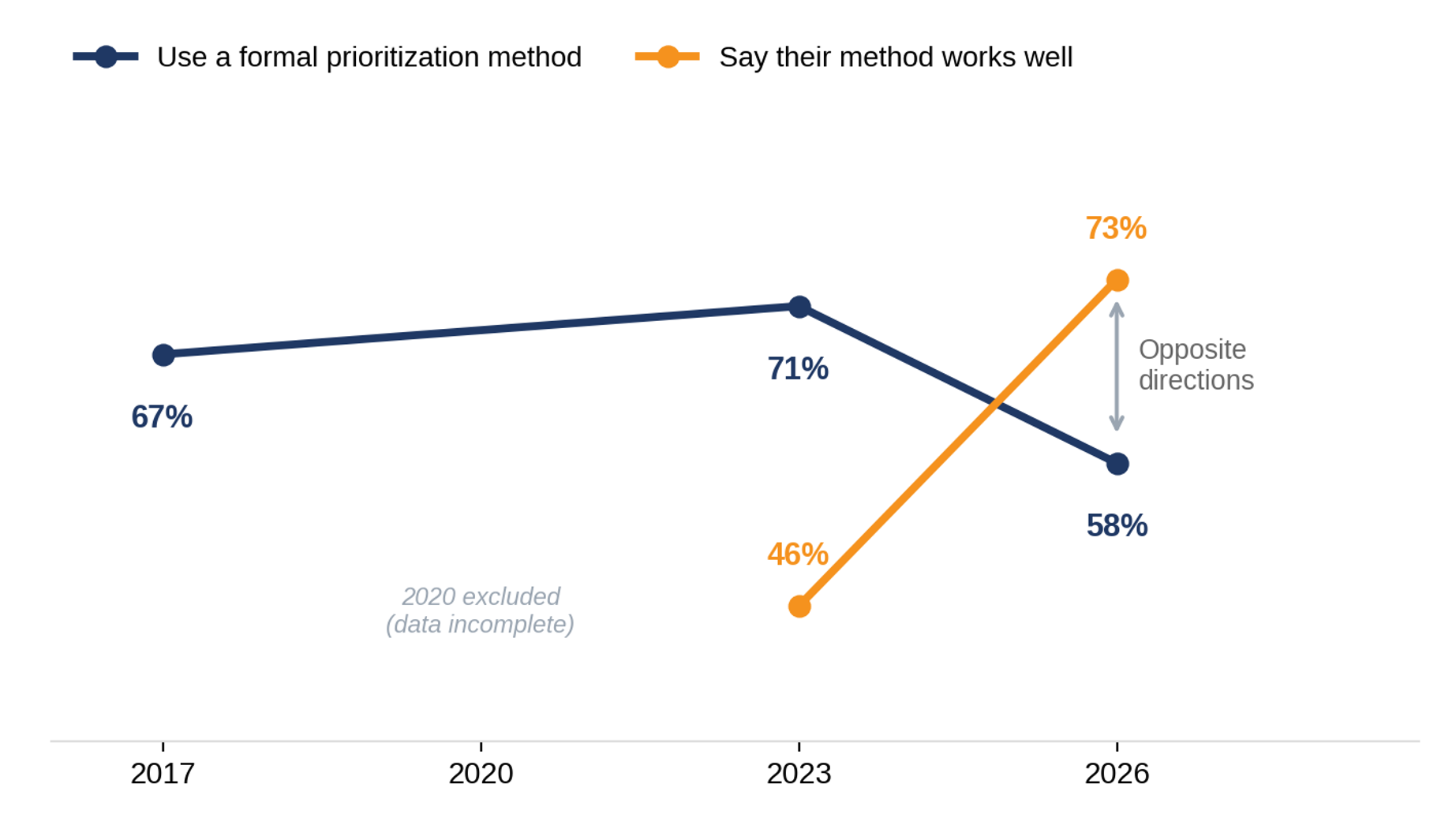
What call centers use points to an explanation. Of those that prioritize, 78% rely on a red flag list and 22% on an online screening tool. Several written responses describe replacing questionnaires with a short symptom list after finding that non-clinical staff could not clarify questions patients misunderstood.
How centers prioritize
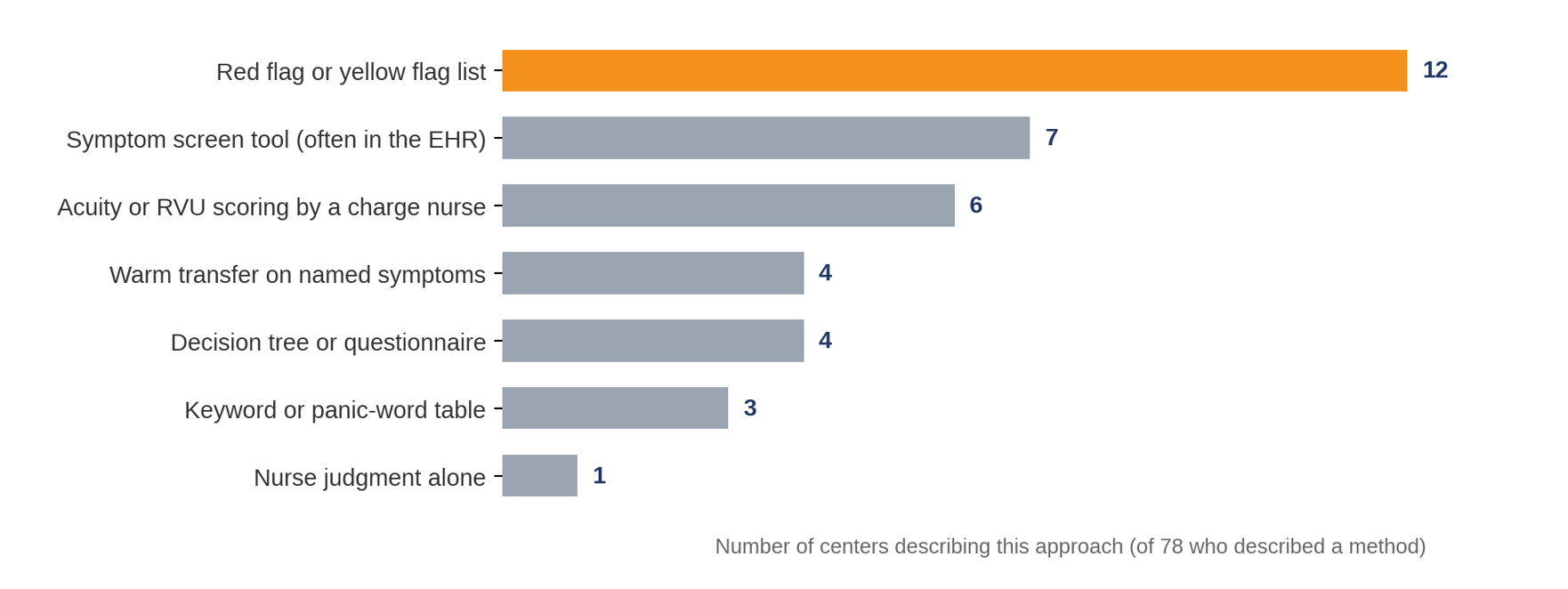
Seventy-eight centers described their method. Seven approaches account for all of them.
A common design
Several call centers described the same three parts. A short red flag list. A warm transfer, where the agent stays on the line until the nurse joins. And a message sent to the nurse regardless, in case the caller hangs up while holding.
One center added a keyword layer underneath. If a non-clinical staff member types certain words into the encounter, the call is flagged high priority automatically.
Reported problems
Non-clinical staff are using problem-based questionnaires to screen calls. This creates confusion and inaccuracies, because patients do not always know how to answer and staff cannot clarify. Calls get routed more urgently than they should be.
Schedulers are not sure what is truly urgent. Sometimes parents sound worried and get pushed through when they are not urgent.
3. Beyond the call
Where the encounter goes once the phone is down.
Written follow-up reached 75%
Post-call information sending nearly tripled since 2017, from 27% to 75%. Photo intake rose from 9% to 45% over the same period. Online nurse chat sits at 11%, and respondents appear to have read that question as portal messaging rather than live chat.
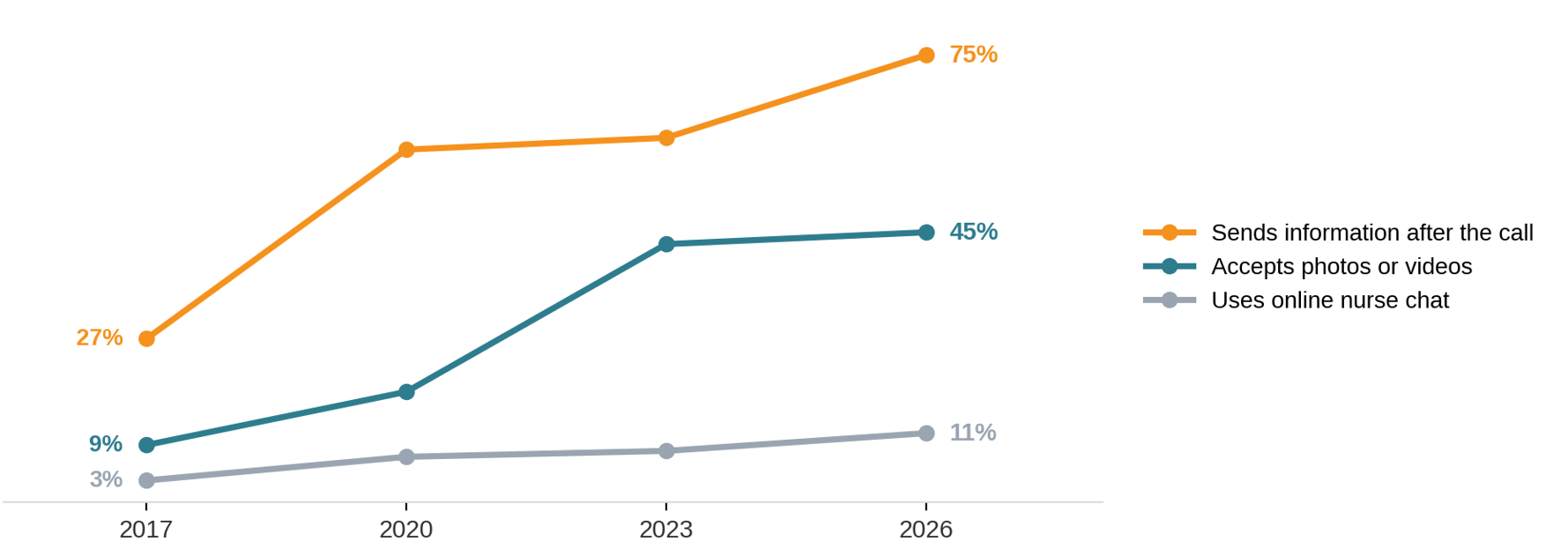
Almost all of this runs through the patient portal rather than direct email or text, which respondents attribute to privacy concerns. The common uses are aftercare instructions, medication dosing, and condition education. Rashes, wounds, and surgical incisions are the symptoms centers most often ask to see.
The combined picture
Ninety-four percent of nurses have the medical record open during the call and 98% of calls include documentation. With written follow-up at 75% and photo intake at 45%, the call is one part of a documented encounter rather than the whole of it.
Not everyone has adopted this. One center limits photo requests on the grounds that the process is time consuming and a thorough assessment usually reaches the right disposition without one.
4. Scope of practice
What triage nurses are authorized to do, and what centers have stopped doing.
Standing order authority crossed 50%
Nurses sending prescriptions under approved standing orders rose from 38% to 52%. Over the same period, the share of centers not handling after-hours renewals at all rose from 35% to 47%. Scope widened in one direction and narrowed in the other.
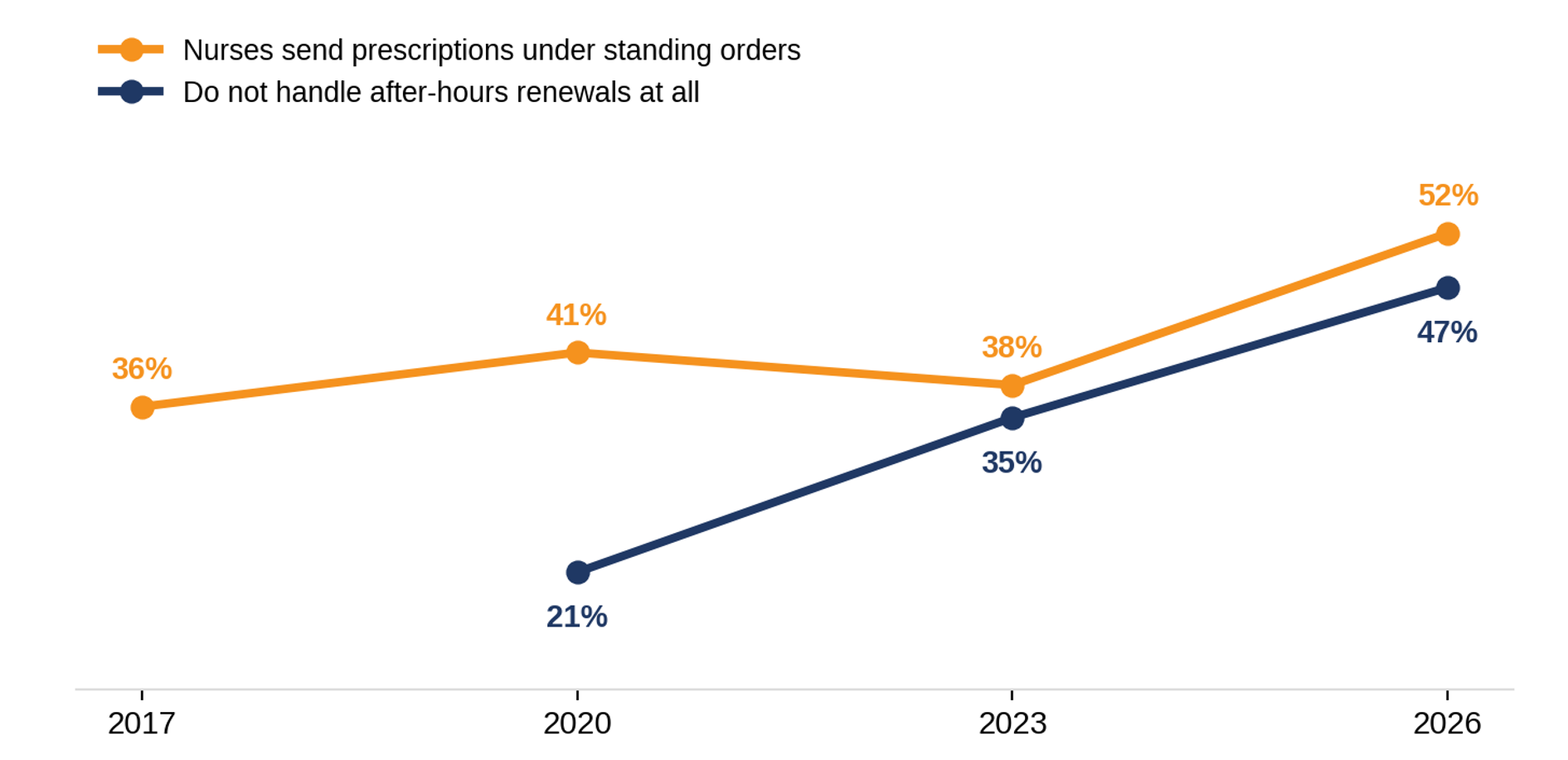
The conditions are consistent across centers: uncomplicated urinary tract infection, conjunctivitis, thrush, swimmer's ear, head lice, vaginal yeast infection, emergency contraception, and influenza. Several centers restrict influenza protocols to periods their medical director activates.
One approach to refills
One center created a team of medical assistants and pharmacy technicians handling all refills and prior authorizations. Nurses route refill requests to that pool and stay on symptom-based calls. Urgent requests are flagged and cleared before end of business.
This is one possible explanation for how call volumes per nurse held steady while the work inside each call grew.
Specialty triage held flat after doubling in 2023
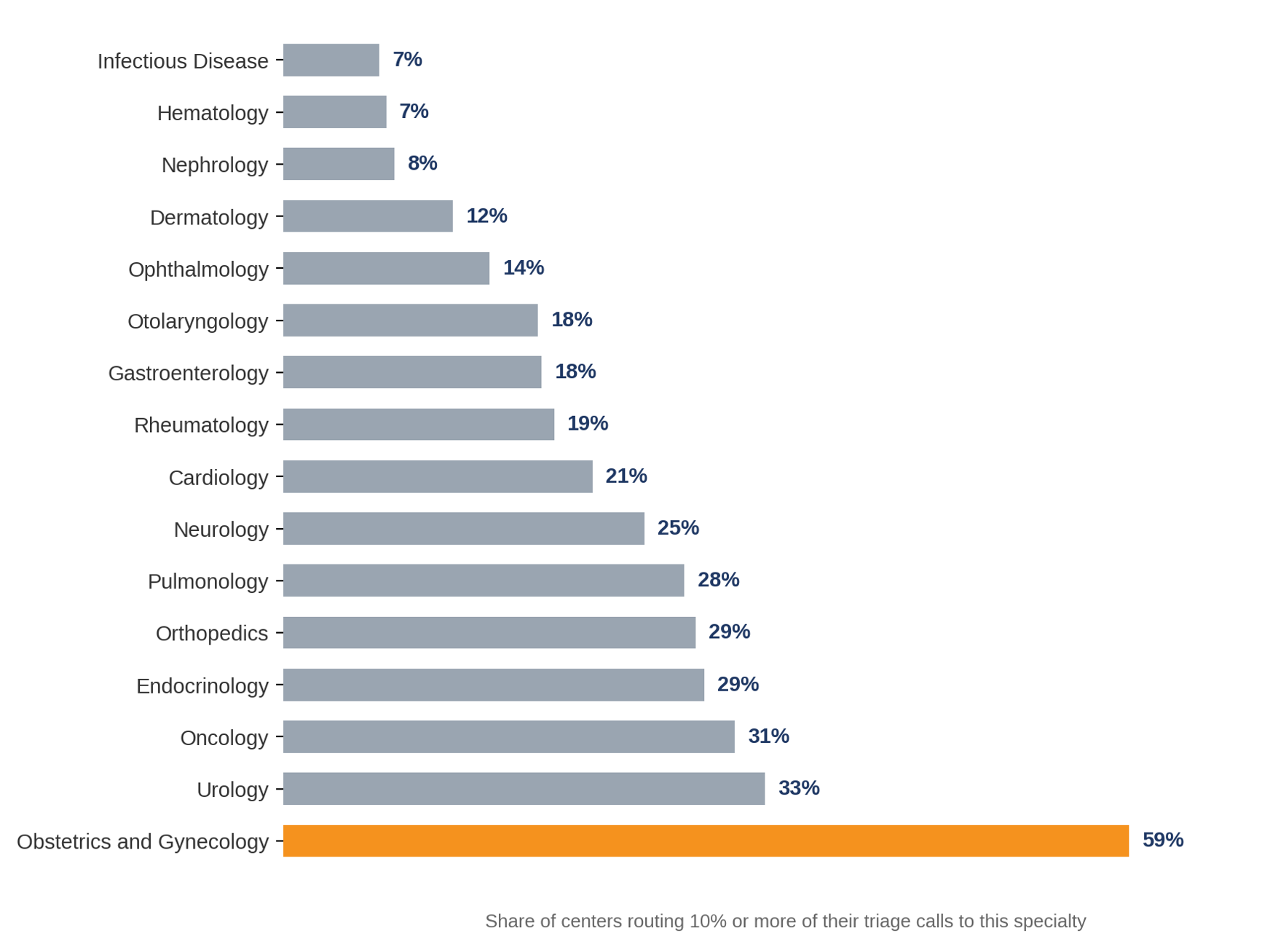
Just under half of centers take specialty calls, roughly unchanged since 2023. Volume stays concentrated. Obstetrics and gynecology is the only specialty where a substantial share of centers route more than 10% of their calls.
Forty percent of centers serve as an access point for telemedicine providers, down from 47% in 2023. Of those, 54% can transfer or schedule a telemedicine visit directly.
5. Risk and oversight
Quality visibility as calls get more complex.
Recording and call review both declined
Four in ten centers no longer record triage calls, down steadily from 85% in 2017. Among those that do record, 4% review 10 or more calls per nurse per month and 23% review fewer than two.
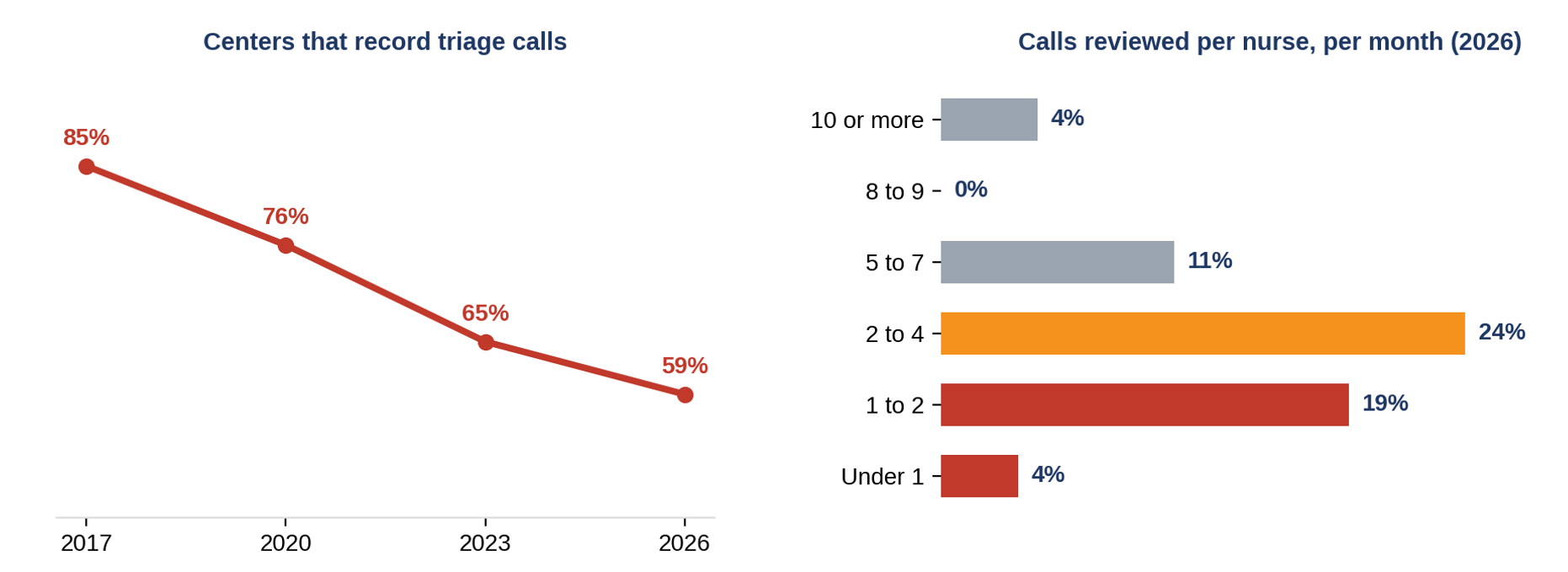
Left: percentage recording triage calls. Right: recorded calls reviewed per nurse per month, 2026.
Reading these together
Fifty-three percent of centers attribute longer calls to higher patient acuity. Fifty-one percent of calls now involve secondary triage by a provider.
Against declining recording rates and low review volumes, a growing share of centers is handling more complex calls with less ability to see how those calls went.
Centers that maintained review describe tiering it by tenure. One reviews new nurses daily for five days, then weekly for eight weeks, monthly through the first year, and quarterly after that, with additional reviews triggered by client inquiries.
Seven in ten centers do not measure caller satisfaction
Seventy percent report no specific measurement, up from 57% in 2023. Where measurement exists it is usually an automated survey offered at the end of the call before disconnect.
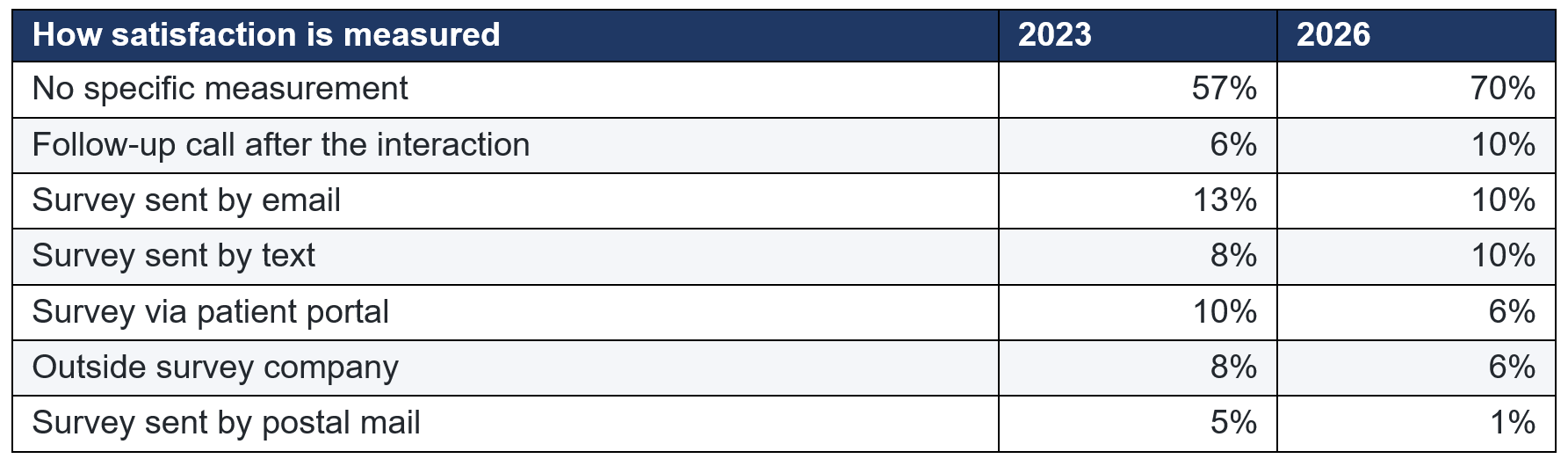
Multiple responses allowed. 2023 n = 184, 2026 n = 51.
Two centers reported scoring the call itself with AI and feeding a patient experience measure, rather than surveying the caller.
6. Staffing at a glance
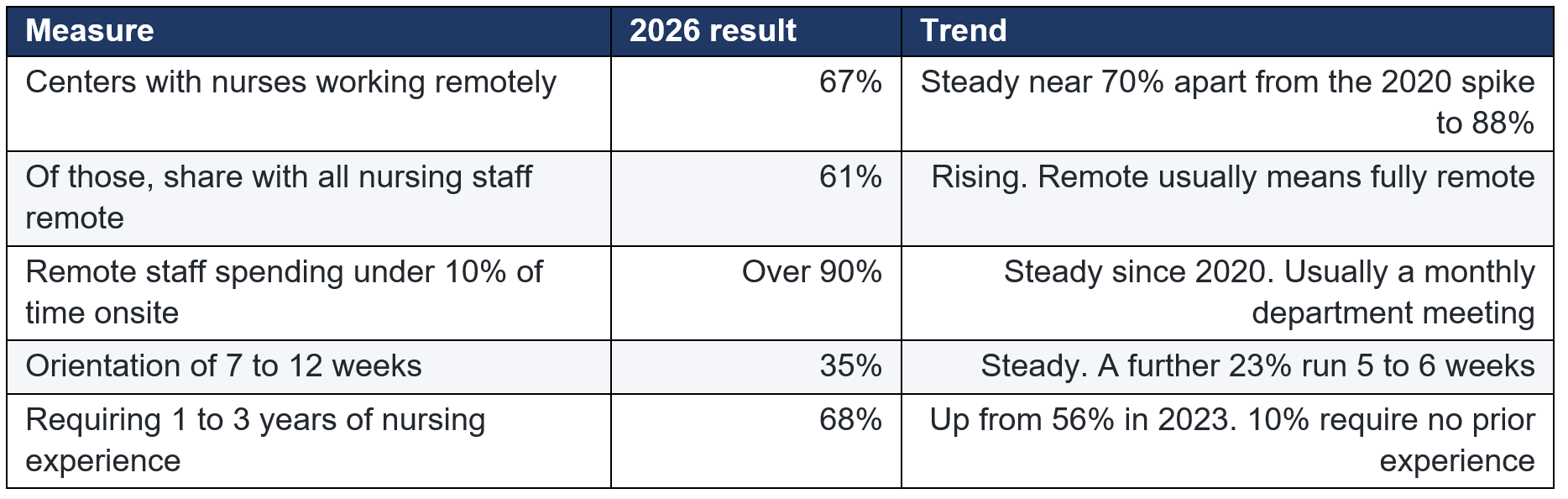
Five measures that changed little this cycle.
Notes for hiring
Remote work is now the default shape of the workforce, and it tends to be all or nothing rather than hybrid.
Orientation runs long. Nearly six in ten centers use five weeks or more, which is worth weighing against the six-month productivity ramp several centers described.
7. AI today
A new question this cycle.
AI use is administrative, not clinical
Ten percent of centers use AI and 25% report working toward it. Sentiment analysis, pre-call information gathering, and automatic call summarization each appear in 20% of the centers using AI at all.
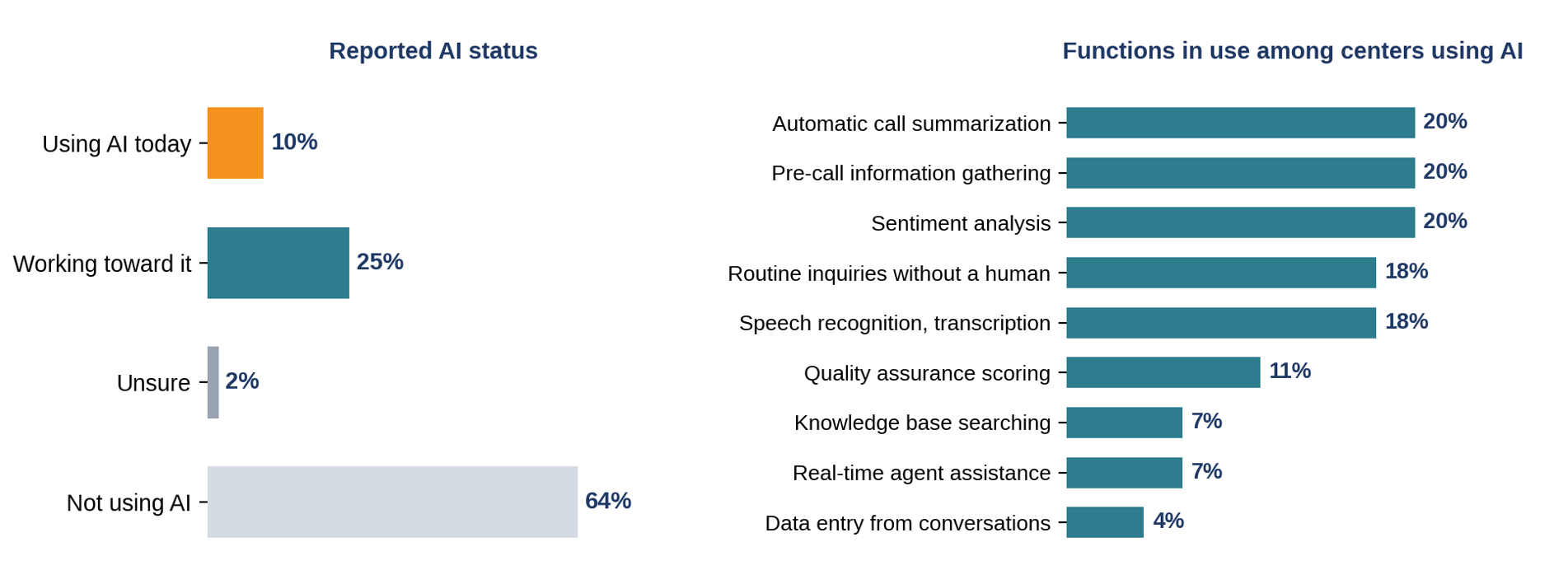
Right panel shows functions in use among centers using AI.
Where centers draw the line
We are working with an AI vendor to help with routing all incoming calls. We will not be using AI for any clinical triage.
Conversational AI tool for documentation purposes and call satisfaction. Not used to guide decision making.
No respondent reported AI participating in a triage decision. The uses named are transcription, summarization, chart review, routing, and quality scoring.
Several centers describe AI arriving through platforms they already run rather than as a separate purchase, including scribes and chart summarization in the electronic record and transcription inside call recording software.
8. The business of triage
How the service is funded and what else it carries.
Fewer centers charge for nurse advice
Charging fell from 52% in 2017 to 19%. Care coordination grew from 36% to 56% over the same period. Class registration calls fell from 48% to 3% as online registration took over.
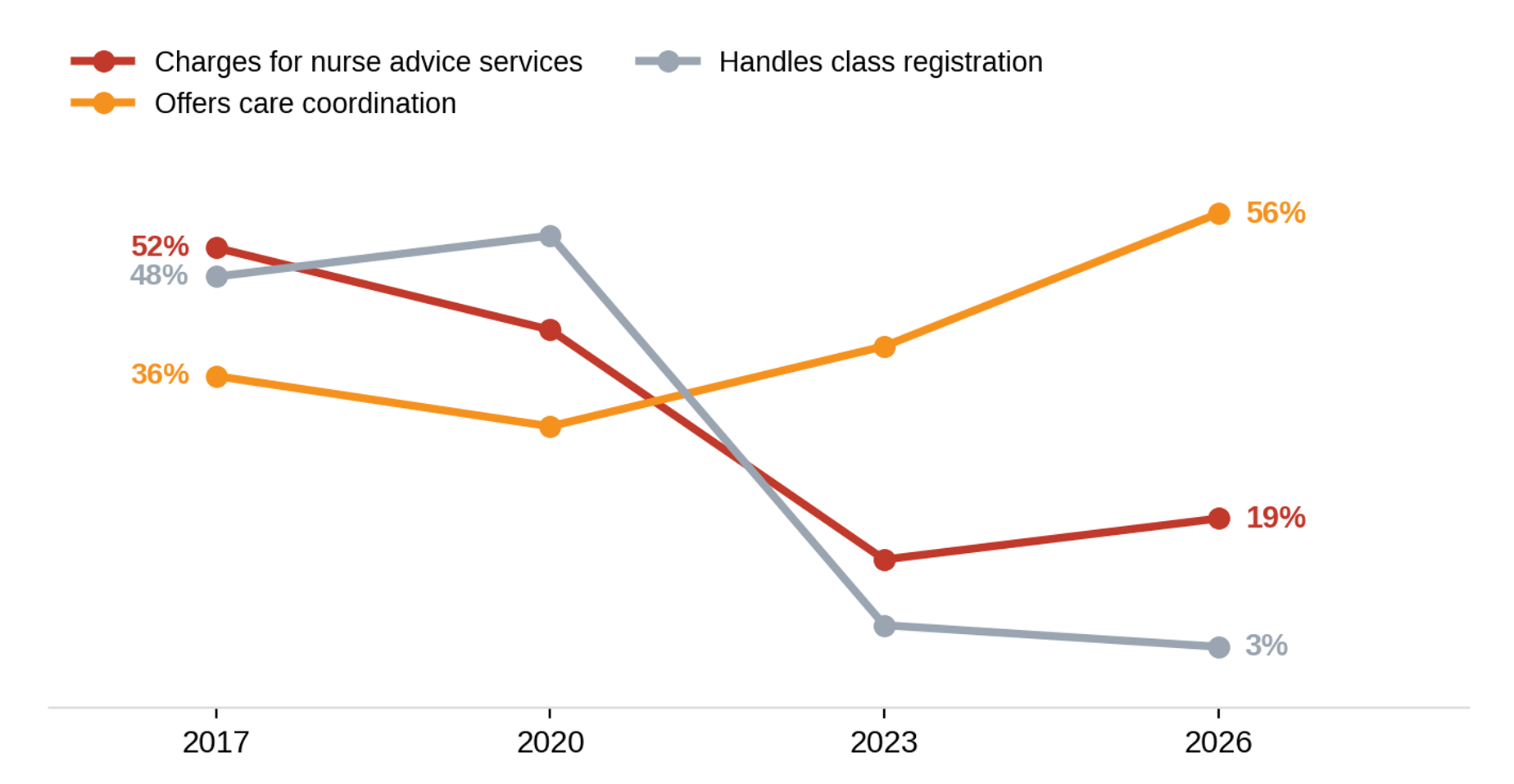
Triage has taken on care coordination, discharge follow-up (46%), and physician referral (36%), while shedding transactional work that self-service handles. Four in five centers now provide the service without charging for it.
Implications
A service that most centers provide without charge, while its scope keeps widening, sits on the cost side of the ledger and carries clinical risk.
That connects to Section 5. If triage is absorbing more complex work without a revenue line attached, the case for maintaining quality oversight has to rest on risk rather than margin.
About this survey
In April 2026, Schmitt-Thompson Clinical Content asked nurses working in telehealth triage for feedback. This included nurses in call centers, provider offices, and clinics. We asked about the services they provide and the operational metrics their contact centers track.
We received 157 responses from nurses and nurse managers across the United States and Canada. Duplicate responses from some organizations, and respondents who did not give an email address, make an exact count difficult, but the results represent roughly 100 organizations. Many questions repeat those asked in 2017, 2020, and 2023, which allows for trending comparisons.
Reading the numbers
Percentages are of respondents answering each question, not of all 157 respondents. Several questions were asked only of a subgroup.
Questions marked as allowing multiple responses will total more than 100%.
Ninety percent of respondents manage both adult and pediatric populations. Roughly a third manage pediatric patients only, double the 2023 share, which may affect some year-over-year comparisons.
Where a prior-year figure is incomplete in the source data, it has been excluded and noted beneath the chart.
Schmitt-Thompson Clinical Content thanks you for your continued support of our research endeavors and making the world of telehealth triage safer. For more information, please reach out to info@stcc-triage.com.